Aalamdar

Between two continents, between two thousand years

Istanbul

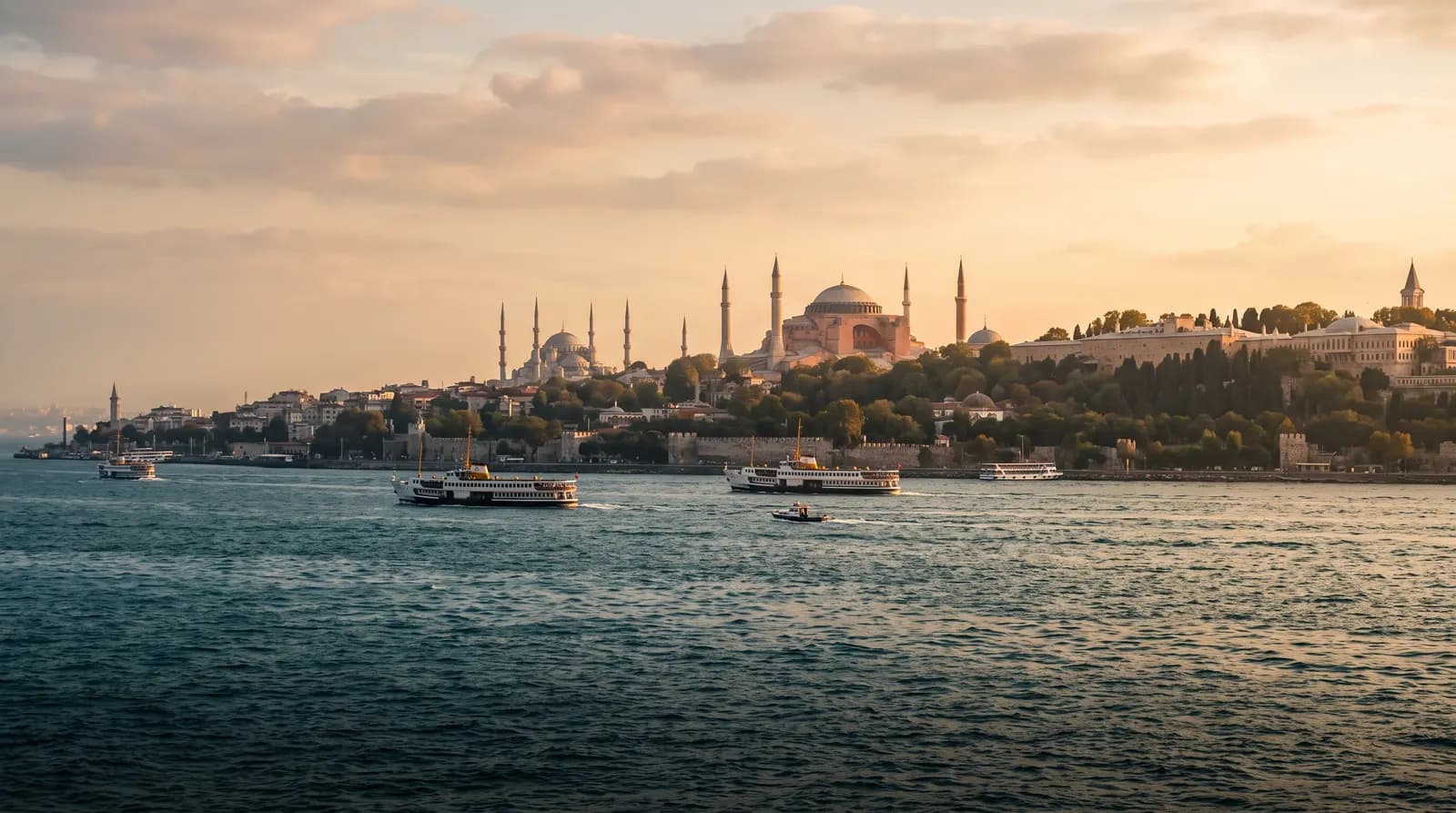
Istanbul spreads across both banks of the Bosphorus, the narrow strait that separates Europe from Asia. Once Byzantium, then Constantinople, it served as an imperial capital for more than fifteen centuries, and every layer of that history is still visible in its skyline.

Scroll to explore

The city

Getting to know Istanbul

A city on the water

Water defines Istanbul. The Bosphorus runs for roughly thirty kilometres between the Black Sea and the Sea of Marmara, while the Golden Horn cuts a sheltered inlet into the European side. Ferries criss-cross all day, and for many residents the commute between continents is simply part of the morning.

Türkiye's largest city is home to more than fifteen million people, yet it is a patchwork of distinct neighbourhoods: the historic peninsula of Sultanahmet, the steep streets of Galata and Beyoğlu, the waterfront villages of the upper Bosphorus and the relaxed, residential Asian side around Kadıköy and Üsküdar.
Empires written in stone

Founded as the Greek colony of Byzantium, the city became Constantinople, capital of the Eastern Roman Empire, in the fourth century. After 1453 it was the heart of the Ottoman Empire until 1922. Roman walls, Byzantine churches, Ottoman mosques by the architect Mimar Sinan and nineteenth-century palaces stand within a short walk of one another.

Few cities let you take a ferry from one continent to another on the way to dinner.

Food, markets and everyday life

Istanbul eats well and often. Mornings begin with simit and tea, lunches are built around meze, grilled fish and slow-cooked dishes from family-run lokantas, and evenings drift towards the waterfront. The spice market and neighbourhood bazaars remain living places of trade rather than museums.

Spring and autumn are the most comfortable seasons; summers are warm and humid, winters cool and rainy, with occasional snow. Distances are large and traffic can be heavy, so the ferry, metro and tram networks are often the quickest way to move.

A centre for medical travel

Istanbul has one of the largest concentrations of private and university hospitals in the region, including facilities accredited by international bodies, and it is the main gateway for international patients arriving in Türkiye. Its two international airports connect it directly with much of the world, which makes it a practical base for consultations, procedures and follow-up visits.

Landmarks

Places that tell the story

The sites, streets and landscapes that give the destination its character — with nearby excursions marked as such.

  • Sacred architecture

    Hagia Sophia

    Completed in 537 under Emperor Justinian, its vast dome was an engineering marvel for nearly a thousand years. It has served as a cathedral, a mosque, a museum and, since 2020, a mosque again; visitors are welcome outside prayer times.

    Sultanahmet, historic peninsula

  • Sacred architecture

    Sultan Ahmed Mosque

    Known as the Blue Mosque for the İznik tiles lining its interior, it was built between 1609 and 1616 and is distinguished by its six minarets and cascading domes.

    Facing Hagia Sophia across Sultanahmet Square

  • Museum

    Topkapı Palace

    For roughly four centuries the residence and administrative centre of the Ottoman sultans. Its courtyards, treasury and Harem now form one of the country's most visited museums, with views over the Bosphorus.

    Sarayburnu, at the tip of the historic peninsula

  • Viewpoint

    Galata Tower

    Built by the Genoese in the fourteenth century, the stone tower rises above the Galata quarter and offers a panoramic view across the Golden Horn to the historic peninsula.

    Galata, Beyoğlu

  • Bazaar

    Grand Bazaar

    One of the oldest and largest covered markets in the world, begun in the fifteenth century. Its vaulted lanes hold thousands of shops selling carpets, jewellery, ceramics, leather and textiles.

    Beyazıt, historic peninsula

  • Waterfront

    The Bosphorus

    The strait between Europe and Asia is best seen from the water. A public ferry or a cruise passes Ottoman palaces, wooden waterfront mansions known as yalı, fortresses and the great suspension bridges.

    Departures from Eminönü, Karaköy, Beşiktaş and Üsküdar

Rest and renewal

The art of renewal

Quiet settings, traditional bathing culture and landscapes that invite a slower pace — places many visitors seek out before or after a period of care.

  1. 01Hammam tradition

    Historic hammams

    Bathing in a hammam is one of Istanbul's oldest rituals: warmth, steam, a scrub on a heated marble platform and time to rest afterwards. Several historic bathhouses designed by Mimar Sinan, among them Çemberlitaş, Kılıç Ali Paşa and Ayasofya Hürrem Sultan, have been restored and welcome visitors.

    Good to know: Heat and steam are not suitable for everyone, particularly after surgery or with heart or blood-pressure conditions. Ask your doctor first.

  2. 02Natural setting

    Belgrad Forest

    A large forest on the city's northern edge with shaded walking and jogging paths around historic reservoirs. It offers fresh air and quiet within a short drive of the centre.

    Good to know: Main paths are wide and fairly level; weekends are busier.

  3. 03Natural settingNearby excursion

    Princes' Islands

    A short ferry ride from the city, these islands in the Sea of Marmara have largely car-free streets, pine-scented hills and old wooden summer houses — a calm change of rhythm for a day.

    Sea of Marmara, roughly 1 to 1.5 hours by ferry

    Good to know: Some streets are steep; small electric vehicles serve the main routes.

  4. 04Medical facilities

    Hospitals and clinics

    Istanbul offers a wide range of private and university hospitals across most specialties. Our coordinators can help identify appropriate, verified providers for your needs.

    Explore Medical Services

These places are offered for general rest and wellbeing. None of them treats or cures a medical condition, and none replaces care or rehabilitation prescribed by your clinician. Suitability depends on your health and mobility — please ask your doctor before planning activities, thermal bathing or travel after a procedure.

Istanbul

The character of the city

Between two worlds

Istanbul never quite chooses between East and West, old and new, and that refusal is its charm. A call to prayer drifts over a tram line; a Byzantine cistern sits beneath a busy office street.

Visitors often arrive for one reason and stay curious for many more. The city rewards slow walking, unplanned detours and an evening on the water as the lights come on along both shores.

“The city where two continents meet, and a thousand untold stories refuse to sleep.”

Healthcare assistance

Planning a journey for your health?

Discover how our team can help coordinate your medical journey in Türkiye, from finding appropriate healthcare providers to organising appointments and related assistance.

Explore Medical Services